Dr. Alexy Khrabrov: AI Pioneer, Community Architect, and Visionary of the Agentic Era

Press enter or click to view image in full size
Long before “agentic AI” entered the mainstream lexicon, Dr. Alexy Khrabrov was building its intellectual foundations. In 1999, working alongside George Cybenko at Dartmouth, Khrabrov co-authored Information Architecture and Agents, a landmark survey of the architecture and properties of intelligent information agents — work that laid out the design space for autonomous, goal-directed software at a time when most of the field was focused on narrow classifiers and rule-based systems. That paper developed a formal model for information agents and raised foundational questions about the future design of general, programmable agents — questions that only became urgent to the broader industry two decades later. This wasn’t isolated curiosity: Khrabrov’s body of research consistently centered on the idea that intelligence emerges from agents acting in dynamic, information-rich environments, from social networks to mobile sensing to the open internet.
Khrabrov’s doctoral work pushed these ideas further, into the real-time pulse of the emerging social web. His thesis produced Discovering Influence in Communication Networks Using Dynamic Graph Analysisand the companion paper Exploratory Community Sensing in Social Networks, which proposed using Twitter as a live sensor, tracking individuals and communities of interest, characterizing individual roles and the dynamics of their communications, and introducing a novel algorithm for community identification based on direct communication rather than linking. Most strikingly, this work produced the first dynamic metrics for social networks accounting for both global and local influence — combining PageRank-style authority with direct reply behavior — metrics applicable across communication networks of any kind. At a time when Twitter was barely two years old and most analysts were still debating whether it was a toy, Khrabrov was already treating it as a living influence graph, measurable in real time. This was graph-native AI thinking before graph databases existed as a category — and it anticipates, with uncanny precision, the knowledge graph and network analysis workloads that define modern AI infrastructure.
Perhaps the most prescient of Khrabrov’s contributions is his 2009 paper, A Language of Life: Characterizing People Using Cell Phone Tracks, co-authored with Cybenko. The paper demonstrated that continuous streams of data from mobile devices — specifically cell phone location tracks from the MIT Reality dataset — could reliably characterize individual people, by treating each person’s movement data as a separate language and building standard n-gram language models for each. The implications were staggering: results showed that medium-scale movement behavioral patterns, at the granularity of cell tower footprints, could distinguish one individual from another. This was, in essence, a proof-of-concept for applying sequential language modeling to any stream of human behavioral data — the precise intellectual move that would, years later, underpin large language models applied to everything from genomics to financial time series. Khrabrov saw, well ahead of the field, that language is not merely words: it is the universal grammar of sequential experience.
It’s worth mentioning that Dartmouth is the birthplace of Artificial Intelligence, CPU timesharing with Multics, educational programming languages with BASIC, the first remote computer connection (to Boston), and much more. Prof. Cybenko. Alexy’s Dartmouth advisor, is the author of the Universal Approximation Theorem, proving that any reasonable function can be approximated by a neural network. The pioneering agentic architectures were naturally informed by such context.
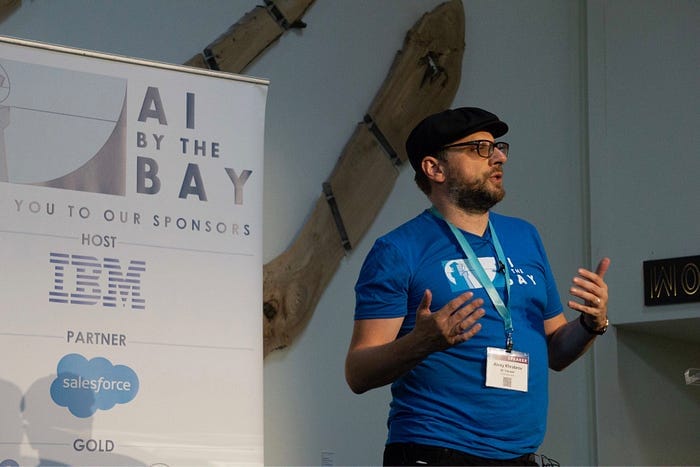
Parallel to his research, Khrabrov built what would become one of the most enduring independent AI event ecosystems in the world. He founded the Scale/Data/AI By the Bay conferences — an independent OSS AI conference running continuously since 2013 — and later the LLM Avalanche conference series, tracking the explosive rise of large language models. These events became known for their rigorously technical, practitioner-first programming, free of vendor theater. He is also the founder and organizer of the Bay Area AI and AI Agent SF meetups, the latter a focal point for the community of engineers and researchers actively building the next generation of agentic systems. Bay Area AI has been recognized as the longest-running and deepest technical AI meetup in the world.
Khrabrov’s community stewardship extends far beyond meetups. He is a cofounder of the AI Alliance and was the founding Chair of the Generative AI Commons at the Linux Foundation for AI and Data. At NumFOCUS, he is the creator Founding Chair of Open-Source Science— an initiative dedicated to advancing open, reproducible scientific computing. Dr. Khrabrov created OSSci when he was the Director of Open-Source Science at IBM Research, staffed it, structured it as an organization, established the Steering Committee, working groups, brought in their chairs, and ran it as a program. Most recently, Alexy has founded the Community Research for Reliable AI at the Northeastern University, a global institution with 14 campuses around the world. CR4AI is based at Northeastern Oakland, formerly Mills, and is meant to validate AI, transforming the whole society, with the Microsoft of a university, industry and OSS community, representing the whole of society. These organizations represent sustained, hands-on work convening researchers, engineers, and institutions around shared open-source infrastructure, governance, and norms. Across all these organizations, Khrabrov has operated as an architect of trust: building the neutral ground where competitors collaborate and where good ideas outlast any single company’s product cycle.
The community-centric approach to open-source AI is, it turns out, a profound competitive and strategic asset. In an era when developer mindshare determines platform success, the communities Alexy builds are the soil in which go-to-market strategies take root. Engineers who learn a technology through a trusted meetup, a non-commercial conference, or an open-source commons become its most credible advocates — not because they were marketed to, but because they were respected as peers. For organizations navigating agentic AI transformation, where the complexity of multi-agent orchestration demands deep practitioner expertise and open standards, this bottom-up trust is irreplaceable. Alexy model — convene openly, build in public, let the best ideas win —is how durable technical ecosystems are made, and how the companies embedded in them earn the right to lead.