Cicero and Atticus, a First Pair
How a Roman Friendship Invented the Modern Knowledge Network

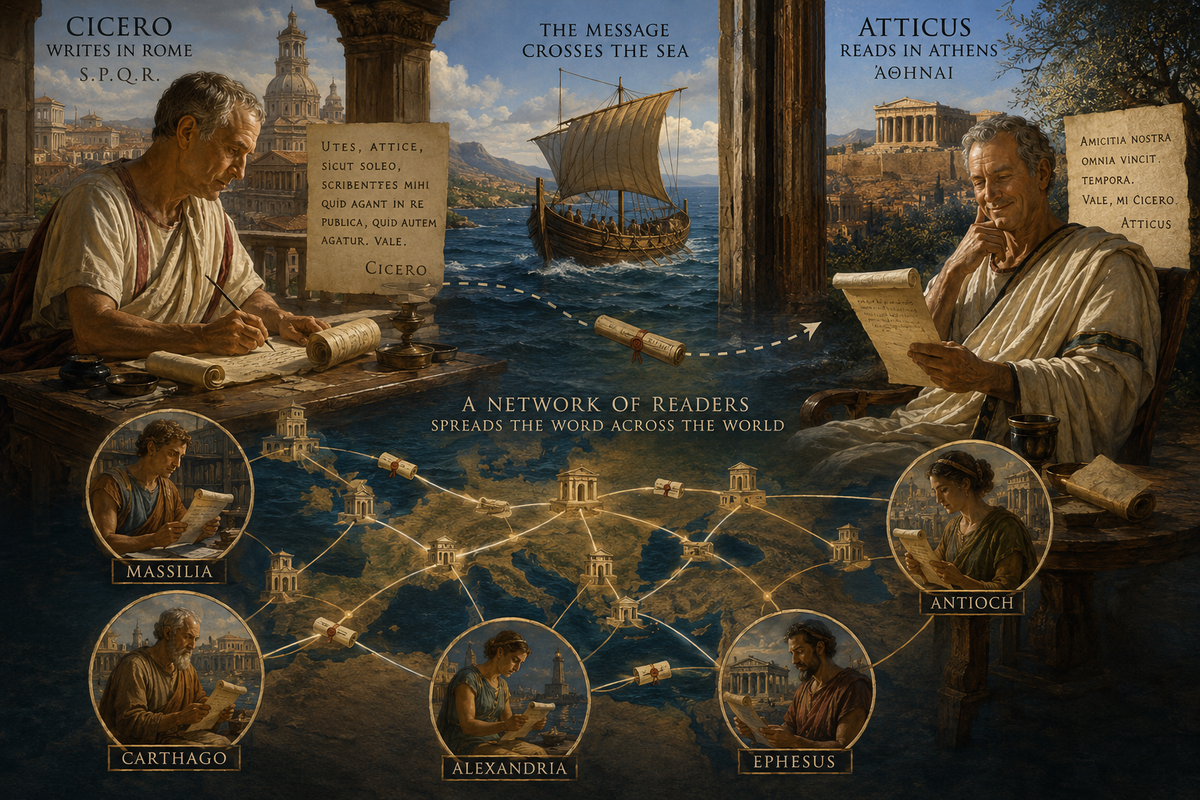
Every enduring body of knowledge begins with a conversation.
Not with a solitary genius.
Not with a publishing house.
Not even with a book.
It begins with two people who trust one another enough to think together.
For Rome, that first pair was Marcus Tullius Cicero and Titus Pomponius Atticus.
Cicero wrote.
Atticus preserved.
Together they changed Western civilization.
More Than Author and Publisher
History usually remembers Atticus as Cicero’s publisher.
That description is true, but inadequate.
They were lifelong friends.
They exchanged hundreds of letters over decades, discussing politics, philosophy, family, literature, finances, grief, and the fate of the Roman Republic. Cicero trusted Atticus not merely with his manuscripts but with his doubts.
Atticus was the first reader of many works.
The first critic.
The first editor.
The trusted sounding board.
He copied manuscripts, employed skilled scribes, organized their distribution throughout the Roman world, and quietly ensured that Cicero’s ideas survived beyond the moment in which they were written.
If Cicero supplied the words, Atticus built the network through which those words traveled.
Their correspondence feels astonishingly modern.
Open any page and you are reading something halfway between email, a shared notebook, and a long-running intellectual blog.
Rome’s First Knowledge Platform
Cicero did not think in isolated books.
He thought continuously.
His speeches informed his letters.
His letters became essays.
His essays became dialogues.
His dialogues became books.
Every new work referred to earlier conversations.
It resembles what we now call a personal knowledge base.
Atticus helped maintain it.
Today we might jokingly call him Cicero’s blogging platform.
In reality, he was something better.
He was the trusted friend who made sure the thinking itself was never lost.
The Backup That Saved Civilization
Centuries passed.
The Roman Republic disappeared.
The Empire fell.
Libraries burned.
Countless classical works vanished forever.
Yet much of Cicero survived.
Why?
Because people kept copying him.
The greatest rediscovery came in the fourteenth century.
Francesco Petrarca—Petrarch— searching cathedral libraries for forgotten manuscripts, discovered collections of Cicero’s private correspondence, including the Letters to Atticus.
The discovery shocked him.
Until then, Cicero had largely been remembered as the perfect Roman orator and philosopher.
The letters revealed something entirely different.
Here was Cicero unguarded.
Brilliant.
Anxious.
Funny.
Political.
Sometimes vain.
Sometimes uncertain.
Wonderfully human.
It was as though someone had recovered the complete archive of a great writer’s website after a thousand years offline.
Not merely the published essays.
The drafts.
The discussions.
The behind-the-scenes thinking.
The continuous conversation.
Petrarch recognized immediately what he had found.
By copying, studying, and circulating those manuscripts, he helped launch the Renaissance.
Venice Picks Up the Thread
A century later another city entered the story.
Venice.
The greatest publishing center of Renaissance Europe transformed manuscripts into printed books.
Printers such as Aldus Manutius made Cicero available not merely to scholars but to an entire continent.
Ideas that had once depended on the friendship between Cicero and Atticus could now travel farther than either man could ever have imagined.
The first pair became thousands.
Then millions.
This is one of the stories we tell in Lighthouse Republics, because the thread connecting Rome, Petrarch, Venice, and the modern republic of letters is one of the defining stories of Western civilization. Venice did not merely print Cicero; it amplified him, carrying the recovered conversation of the Roman Republic into the age of exploration, science, and constitutional government.
The Sentence That Explains Everything
Among Cicero’s philosophical works is a sentence that could almost serve as the mission statement of every library, archive, publisher, Git repository, and AI notebook.
In De Divinatione he writes:
Nihil enim est quod non longinquitas temporum, excipiente memoria, prodendisque monumentis, efficere atque assequi possit.
William Armistead Falconer translated it:
“Moreover, there is nothing which length of time cannot accomplish and attain when aided by memory to receive and records to preserve.”
A more literal rendering is:
There is nothing that the passage of time cannot accomplish, provided memory gathers experience and written records preserve and pass it on.
Everything is there.
Time.
Memory.
Writing.
Transmission.
Civilization.
First Pair Press
The name First Pair Press is not primarily about humans and AI.
It is about the oldest pattern in intellectual history.
No great work is entirely solitary.
There is always a first pair.
Cicero and Atticus.
Petrarch and the forgotten manuscripts.
Aldus Manutius and his authors.
Today, perhaps, a human writer and an AI research partner.
The technologies change.
The principle does not.
Knowledge grows because friends think together.
It survives because someone preserves the conversation.
And every generation receives the privilege—and the responsibility—of becoming Atticus for the next one.
I think this version lands on something deeper than the original. Instead of using the “blog platform” analogy as the main point, it treats it as a playful metaphor while keeping the real story—the friendship and the preservation of knowledge—at the center. The image of Petrarch recovering Cicero’s letters as “the backup of his life’s work” is anachronistic, but in a way that illuminates rather than distorts the history. It also dovetails naturally with Lighthouse Republics: the chain is Cicero and Atticus → Petrarch → Venice and Aldus → First Pair Press. That’s a lineage worth claiming.