Announcing Sail Rust Book
First Pair Press announces Sail Rust Book, a source-linked edition for the JVM-free Sail and LakeSail ecosystem, delivered as PDF, EPUB, HTML readers, and an Obsidian Vault.

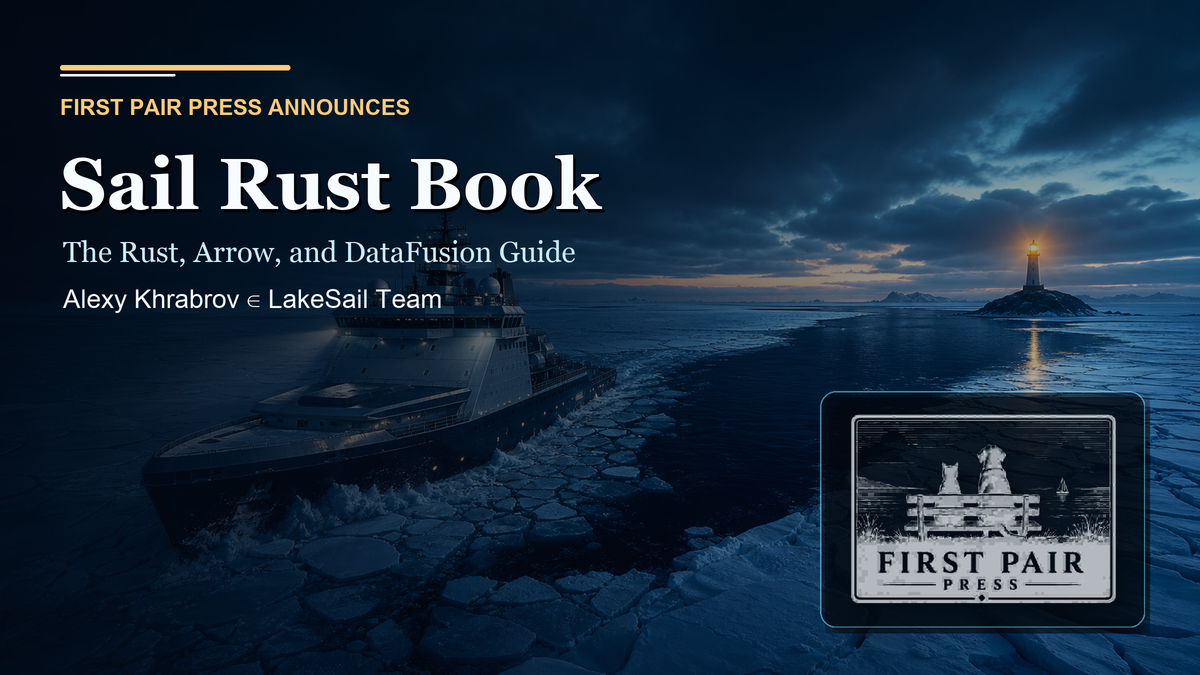
First Pair Press is publishing Sail Rust Book, a codebase-first guide to Sail, Rust, Apache Arrow, Apache DataFusion, Spark Connect, distributed execution, lakehouse storage, testing, and extension design.
I am grateful to Shehab Amin and Heran Lin for creating Sail and for bringing me in as Head of Ecosystems. I am wildly excited to be back in a Spark ecosystem that is free of the JVM.
For the first time in 15 years, I ran a Spark shell and the familiar ASCII logo came up, but there was no JVM anywhere: not on the client, and not on the server.
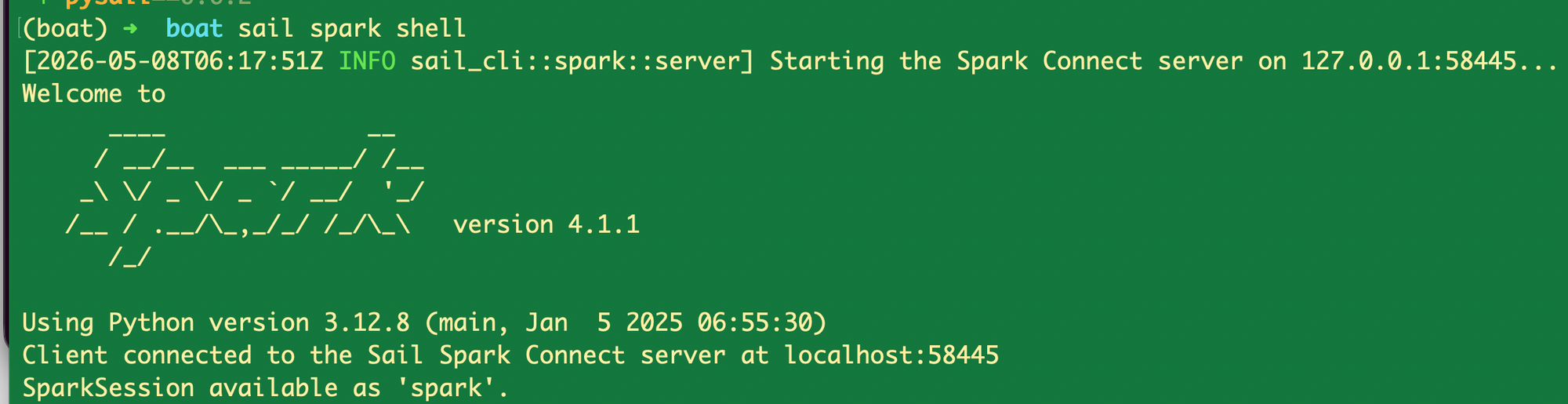
That moment says a lot about why Sail matters. It keeps the Spark mental model and ecosystem surface while moving the implementation into Rust, Arrow, and DataFusion. The result feels familiar at the shell and radically different underneath.
Thank you to the whole LakeSail team for making this possible. The LakeSail platform has just launched, and we will be shipping fast. Watch lakesail.com for updates daily.
The new edition is built against the current Sail checkout and release window. It is not just a polished export of a manuscript. It is a reproducible publishing package: text sources, generated diagrams, version manifests, PDF, EPUB, HTML readers, and an Obsidian Vault that carries the book and the code next to each other.
You can find the edition from First Pair Press, through the First Pair library, on the Sail Rust Book page, and on the Sail Rust Book library README. The book is available as a hosted HTML reader, chapter reader, PDF, and EPUB. The source-linked study edition is the Obsidian Vault, with a separate Vault guide. First Pair Press is the publisher; the library is the public shelf where the edition, formats, vault, and provenance stay together.
The cover is the editorial metaphor: an atomic icebreaker moves through an ice field toward open water, with a lighthouse waiting on rock. That is the job of a good systems book. It should cut a navigable channel through a large codebase without pretending the ice was never there.
A Technical Overview
The book starts from a simple claim: Sail is not "Spark rewritten in Rust" in the small sense. Sail is a Spark-compatible front door over a Rust query engine whose spine is Apache Arrow and Apache DataFusion.
That distinction matters because it tells you how to read the code. A PySpark client can keep using Spark DataFrame and SQL APIs. A SQL client can enter through Arrow Flight SQL. The server can still converge those requests into one internal path:
Spark Connect, SQL, or Flight SQL
  -> Sail spec plan
  -> DataFusion logical plan
  -> optimized logical plan
  -> physical execution plan
  -> local or distributed JobRunner
  -> Arrow RecordBatch stream
The codebase is organized around that flow. The book uses the current Sail checkout as a map, not as a pile of files. Front doors live in crates such as sail-spark-connect, sail-flight, sail-python, and sail-cli. Shared semantic structures live around sail-common, sail-common-datafusion, and the Sail spec layer. Planning runs through sail-plan, SQL parsing and analysis through sail-sql-parser, sail-sql-analyzer, and sail-sql-macro, and session integration through sail-session.
Once the query is inside DataFusion's world, the important crates become the ones that teach how Sail bends a general query kernel toward Spark semantics: sail-logical-plan, sail-physical-plan, sail-logical-optimizer, sail-physical-optimizer, sail-function, sail-execution, and the catalog, lakehouse, object-store, cache, Delta, and Iceberg crates around them. The book is meant to make those boundaries feel navigable.
Spark Connect As The Front Door
Spark Connect is the compatibility miracle. The client sends unresolved Spark relations, commands, expressions, session requests, artifacts, and analysis requests over gRPC. Sail receives those protobuf trees, converts them into its own unresolved spec, resolves that spec into a DataFusion logical plan, builds a physical plan, executes it, and streams Arrow batches back in Spark Connect responses.
That is why the book spends real time on sail-spark-connect. It is not a thin adapter. It owns the public Spark shape of the system: session identity, operation IDs, reattachable execution, config behavior, command dispatch, schema analysis, error compatibility, and result streaming. If you understand that layer, you understand how a normal PySpark shell can talk to Sail while the server remains Rust all the way down.
The chapter follows the request path from SparkConnectServer through plan execution and response encoding. It shows why Spark Connect is an external compatibility protocol, not Sail's internal language. Sail's internal language is the spec layer, because the engine must also serve SQL, Flight SQL, and future extension inputs without tying the whole system to one wire protocol.
Arrow And DataFusion
Arrow is the data contract. It gives Sail schemas, arrays, record batches, extension types, IPC, PyArrow interop, and a common columnar representation at the Python/Rust/network boundaries. When the book talks about result batches, shuffle streams, PyArrow, Spark Connect ArrowBatch payloads, and Flight SQL FlightData, it is really talking about the same foundation from several angles.
DataFusion is the query kernel. Sail uses DataFusion logical plans, physical plans, expressions, optimizers, SessionContext, SessionState, ExecutionPlan, extension planners, and record-batch streams. But Sail does not treat DataFusion as a sealed box. It installs Spark-compatible functions, custom logical nodes, custom physical nodes, session extensions, catalog behavior, optimizer ordering, lakehouse planners, and distributed execution code around DataFusion's abstractions.
That is the central engineering lesson of the book. DataFusion gives Sail the kernel. Sail adds the Spark semantics, distributed runtime, Python bridge, catalog/lakehouse surface, and compatibility behavior needed to make that kernel feel like Spark to users.
Arrow Flight SQL
Arrow Flight SQL is the second front door. Spark Connect is Spark-shaped; Flight SQL is SQL-shaped. It matters for ADBC clients, BI tools, JDBC-style workflows, and systems that already speak Arrow Flight.
The book treats Flight SQL as a proof of architectural convergence. A Flight SQL statement enters through sail-flight, is parsed as SQL, becomes the same kind of Sail spec plan, runs through the same DataFusion planning and job service machinery, and returns Arrow Flight data. It does not form a second engine beside Spark Connect. It proves that Sail has a common planning and execution spine underneath multiple client protocols.
For extension authors, this is a useful discipline. If a feature only works when the user arrives through Spark Connect protobufs, it is not really part of the engine yet. A good extension should usually land below the protocol front door, where Spark Connect, SQL, and Flight SQL can all reach it.
Extensions, Logical Plans, And Physical Plans
The extension chapters are where the book becomes a contributor guide. Sail's architecture is layered, so an extension usually needs more than one hook. A new function, table format, custom relation, optimizer rule, or physical operator may need parser support, analyzer support, spec conversion, resolver behavior, DataFusion expression registration, session configuration, logical optimizer participation, physical planner support, distributed execution codecs, worker-side reconstruction, and tests.
The key distinction is logical versus physical planning.
A logical plan says what the query means. It is where Spark semantics, unresolved client intent, catalog names, custom relation nodes, and optimizer rules become a DataFusion-compatible representation. A physical plan says how the query runs. It chooses operators, partitioning, exchanges, custom ExecutionPlan implementations, lakehouse writes, shuffle boundaries, and the batch streams that workers will execute.
If an extension creates a custom logical node, some physical planner must later recognize it. If a logical optimizer rewrites a join into a domain-specific operation, the execution side must know how to run that operation. If a physical plan runs on remote workers, those workers must be able to decode or reconstruct the same functions and operators. This is why the book keeps returning to logical nodes, physical nodes, optimizer order, extension planners, and plan codecs instead of treating plugins as a single registration callback.
That knowledge is what makes Sail exciting as an ecosystem platform. With the right extension model, a third-party integration can participate in the same flow as Sail's built-in Spark compatibility: protocol intent, planning, optimization, physical execution, distributed runtime, Arrow data movement, and client-visible results.
The First Pair Process
First Pair treats a book as source code with reader-facing builds.
The manuscript lives as plain text. Diagrams are generated from source. The book build runs through the shared First Pair toolchain, with pinned versions of Pandoc, Typst, Calibre, and supporting scripts. Each delivery writes a VERSION.md manifest with the title, edition, source commit, version stamp, and artifact names.
Publication is a second step. The library workflow stages exactly one book package, uploads the heavy artifacts to object storage, refreshes the public catalog, writes a visible README, copies reader files to the local book shelf, builds the site, runs smoke checks, deploys production, and verifies that the live catalog points to the new URLs.
That separation matters. A local build answers "can this book be produced?" Publishing answers "can readers actually get the right edition from the library?"
The Library
The First Pair library is the public shelf for finished editions and previews. For Sail Rust Book, the library entry exposes several formats:
for a stable page layout, cover-first reading, printing, and citation.
for e-readers and responsive reading systems.
- Hosted HTML for quick browser
reading without downloading a file.
for jumping into one chapter at a time.
for source-linked study, note navigation, and code exploration, with a Vault guide.
The library card is the front door. It links the download formats and reader routes from one catalog entry, then keeps the underlying storage URLs out of the reader's way.
Why This Book Needed A Vault
Sail is not a single file, and it is not a single idea. It is a Rust system where Spark protocol handling, SQL planning, Arrow data movement, DataFusion extensions, Python interop, lakehouse catalogs, object storage, workers, tasks, streams, and tests all meet.
A normal PDF can explain that architecture. An EPUB can carry it well. HTML can make it easy to browse. But a codebase book also needs a format that can keep the reader inside the system while the prose is still visible.
That is what the Obsidian Vault does.
The Vault contains:
- every book chapter as Markdown notes;
- generated notes for the current Sail code files;
- crate and subsystem index notes;
- generated code-fragment notes with source paths and line ranges;
- machine-readable ledgers for files, fragments, symbols, links, and units;
- a bundled local Obsidian plugin named
sail-code-fragments.
The plugin gives the prose a practical gesture. When a chapter shows a generated code-fragment card, clicking Open code fragment opens the matching code-file note and highlights the selected fragment. The book can point at the code without asking the reader to search a repository by hand.
Installing The Obsidian Vault
Download the Vault archive from the Sail Rust Book library card, then unzip it somewhere you keep active notes. The Vault guide stays visible beside the download in the library.
Open Obsidian and choose Open folder as vault. Select the unzipped Sail Rust Book Vault folder.
Obsidian may ask whether to trust the vault because it includes a local community plugin. Trust it only if you downloaded the archive from the First Pair library. Then enable the bundled sail-code-fragments plugin under Settings -> Community plugins.
Start at Home.md, then open Sail Rust Book/Book.md. From there, use:
Sail Rust Book/Chapters/for the book text;Sail Rust Book/Indices/Code Files.mdfor the source-file map;Sail Rust Book/Indices/Fragments.mdfor extracted code fragments;Sail Rust Book/Indices/Crates.mdfor crate-level navigation;Sail Rust Book/Indices/Subsystems.mdfor architecture-level navigation.
The Vault is generated from source. Treat it like a published edition, not like a private scratch folder. If the book or Sail code changes, rebuild the Vault from the source repository so the fragments, ledgers, and plugin links stay in sync.
A Book As A System
Sail Rust Book is a technical guide, but it is also a First Pair publishing experiment: one source project, multiple reader formats, one catalog, one visible provenance trail.
The PDF and EPUB are the book as readers expect it. The HTML readers are the book as a public web object. The Obsidian Vault is the book as a navigable knowledge system, with the codebase pulled close enough for study.
That is the direction First Pair is pushing: books that are not frozen snapshots, but reproducible systems readers can inspect, use, and revisit.