Alexy talks with Yann LeCun about a new Global Model

Yann LeCun on Tapestry, Open Source AI, and Why LLMs Are Useful but Not Enough
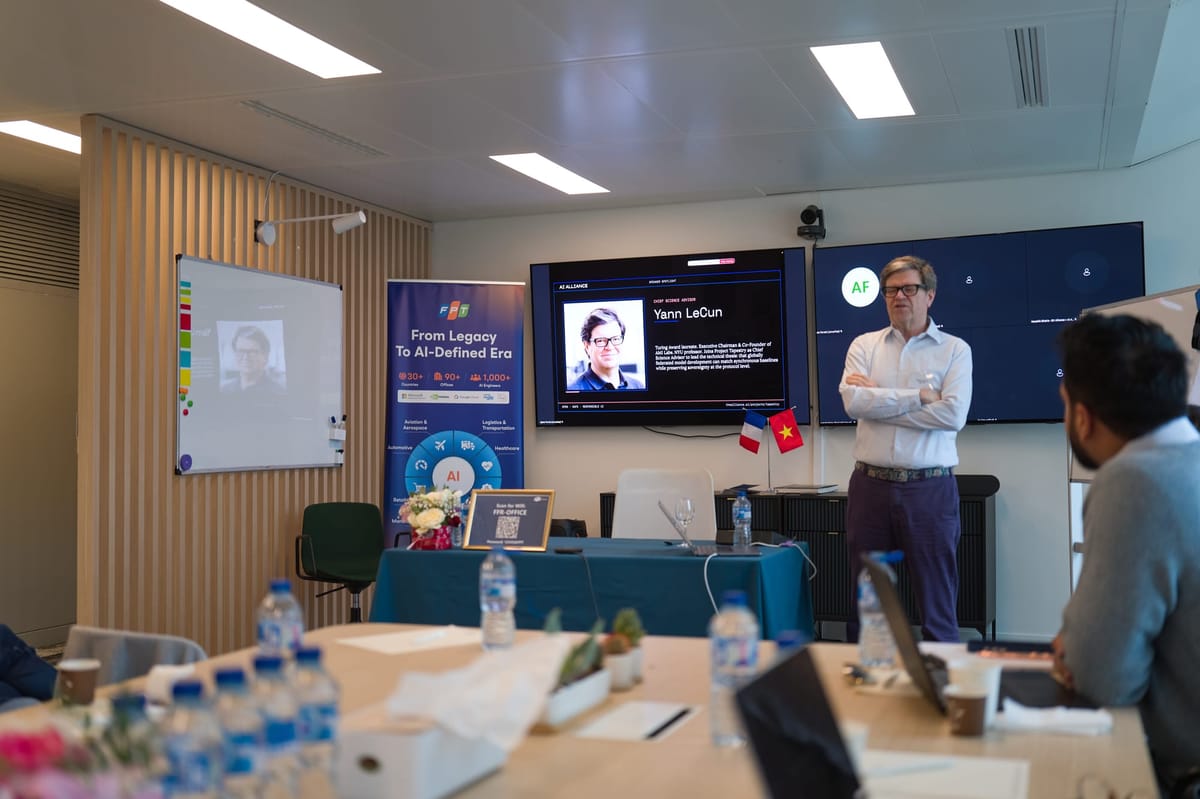
Interview recorded in Paris, France, at Station F, during the Tapestry kickoff workshop.
Alexy Khrabrov speaks with Yann LeCun about Tapestry, an open and collaborative effort to build diverse AI assistants through federated training. The conversation covers AI sovereignty, open source foundation models, distributed training, government and university participation, and LeCun's view that LLMs are useful tools even if they are not a path to human-level intelligence.
Chief Scientist: Yann LeCun, Tapestry Kickoff, Paris
Yann and Alexy in Paris
Transcript
Alexy: Hello everybody. I'm Alexy Khrabrov, formerly the founding community head of the AI Alliance and now head of community at Lakesail. We are here at Station F in Paris with Yann LeCun, scientific advisor to the new Tapestry project of the AI Alliance. Yann, please tell us what Tapestry is, how it came about, and how you became involved.
Yann: Tapestry is an old idea I originally tried to push inside Meta, though it did not go very far there. The idea is that, in the future, many of us will get our information through AI assistants. If those assistants are produced by a handful of companies on the West Coast of the United States or in China, we will not have enough diversity of information sources.
Yann: Tapestry proposes an open source platform: a foundation model on top of which highly diverse AI assistants can be trained. Those assistants should reflect different languages, cultures, value systems, interests, and political viewpoints. The best way to do that is to build a coalition of countries, regions, and contributors that collaborate in a federation to train a frontier model.
Yann: The contributors do not need to exchange data. They exchange parameter vectors. The system is trained collaboratively, everyone has access to it, and each country or region can use local data, local languages, library material, and other resources. I think this is one of the few plausible ways to create broad diversity of AI assistants in the future.
Alexy: You led AI research at Meta, and Llama was a major success. But Llama is not enough for the world because we do not know exactly what data it was trained on, and it does not solve the diversity problem by itself. We have just spent two days at the Tapestry kickoff workshop, with representatives from many countries and labs. How would you summarize the current state of the idea? How should the world build this kind of model as a scientific and open source AI community?
Yann: First, I should make clear that I am no longer at Meta. I left Meta in early 2026 and am now involved in a new company called AMIAS. Tapestry is separate from that. It is a collaborative, non-commercial, open project.
Yann: I have seen strong demand from countries around the world, especially countries that are neither the United States nor China, for some level of AI sovereignty. Switzerland, Germany, France, the UAE, Vietnam, India, Japan, Korea, and others have all made efforts to build their own LLMs. In my view, that is often a waste of resources. These countries should work together and train a common LLM.
Yann: Some countries have also built on top of Llama, but it is no longer clear what role Meta will play in the open source world. Meta has become less open, so there is an important role for an organization like the AI Alliance.
Yann: This is the kickoff meeting. We want to rally talented young people and make the project bottom-up, so people who can contribute technically can do so without going through heavy bureaucracy. I also expect support from governments around the world, whether in money, political support, compute, or other resources, because the demand is very strong.
Alexy: The AI Alliance held meetings at the AI Action Summit in Paris and New Delhi, and you have mentioned that heads of state are interested in this. Governments understand that AI sovereignty matters, and this initiative is responding to a real demand.
Yann: Exactly. Many countries realize that their only path to AI sovereignty is through open source and collaboration. That gives a strong boost to projects like Tapestry.
Yann: The technical infrastructure is important. We want contributors to train models locally on their own data while preserving data sovereignty. They do not exchange the data. The only information that circulates between contributors is model parameter vectors. The models are trained in a distributed way until they arrive at a consensus model that is as good as if it had been trained on all the data accessible to everyone.
Yann: That may also be a way for open models to become better than proprietary models, because they can access more diverse and more regional data than commercial entities can.
Alexy: So this is a technical architecture challenge. It does not fully exist yet.
Yann: No. We still have to figure out the details. We know the techniques exist in prototype form and we know the approach is mathematically feasible, but the engineering details have to be worked out.
Alexy: You are known for saying that LLMs are not a path to AGI or human-level intelligence, and your company is working on world models. But here you are advising a practical project around LLMs because they are useful and there is demand for them. That sounds like a PhD topic, or many PhD topics.
Yann: I have never said LLMs are useless. They are clearly useful. We use them daily, especially for code generation, but also for mathematics, access to information, and many other tasks.
Yann: Most computer technology is useful, but most computer technology is not a path to human-level intelligence. What I have said is that LLMs are not a path to AGI, or more precisely, not a path to human-like intelligence. They are still useful.
Alexy: You operate across academia, startups, and government advice. The AI Alliance also has a lot of brainpower and institutional reach. How should we engage people around the world? We need PhD students in leading universities, government labs that are already investing in national LLMs, and companies that want a more open path.
Yann: There are strong motivations at several levels. For governments, the motivation is sovereignty: not being dependent on technology from the United States or China.
Yann: For companies, the motivation is also independence. They do not want to depend on a supplier that can change license terms overnight. With Tapestry, they would have access to a frontier open model, including source code, training code, and at least part of the training data. It would be much more open than current open-weight models, and companies could fine-tune it or build on it as needed.
Yann: The most important motivation is for individual contributors. The mission is to protect democracy and cultural diversity by ensuring that people have access to a wide variety of information sources. People should not receive information filtered only by someone in Silicon Valley, Beijing, or anywhere else. With a Tapestry foundation model, communities can fine-tune assistants with their own data, perspectives, and value systems, and provide assistants to people who share those interests.
Yann: We need a diversity of assistants for the same reason we need a diversity of newspapers, magazines, and other information sources. That mission is motivating. There are also very interesting technical problems to solve.
Alexy: One of those problems is how to train a large model in a distributed way across data centers around the world that cannot communicate synchronously. Each contributor trains on a subset of the data, but all of them need to contribute to a common model. There is also the question of commodity hardware: can smaller GPUs make useful contributions instead of only the latest expensive Nvidia chips?
Yann: That remains to be invented or at least fine-tuned. There are techniques, but we do not know whether they work at that scale. It is a good project for several PhD students.
Alexy: Are you planning to advise PhD students working on this?
Yann: Distributed training is not my main area of expertise or the main topic of my research. There are people at this meeting who are much more expert than I am. I would be happy to provide advice, and I did write a paper on distributed training about twelve years ago, but many people know more about this than I do.
Alexy: The AI Alliance includes many universities around the world, so if you are a PhD student watching this, please connect with the Alliance. We can route you to people who may be able to supervise this work. It is an important scientific problem for the world.
Yann: Everything remains to be built. We have a GitHub, but it is essentially empty at this point. If you have good ideas, come in. We do not yet have a fixed technical organization or technical leader, so good contributions will be heard.
Alexy: Thank you very much, Yann. I look forward to seeing Tapestry succeed under your scientific leadership.
Yann: Thank you.