All 12 Rust AI Begins recordings are live

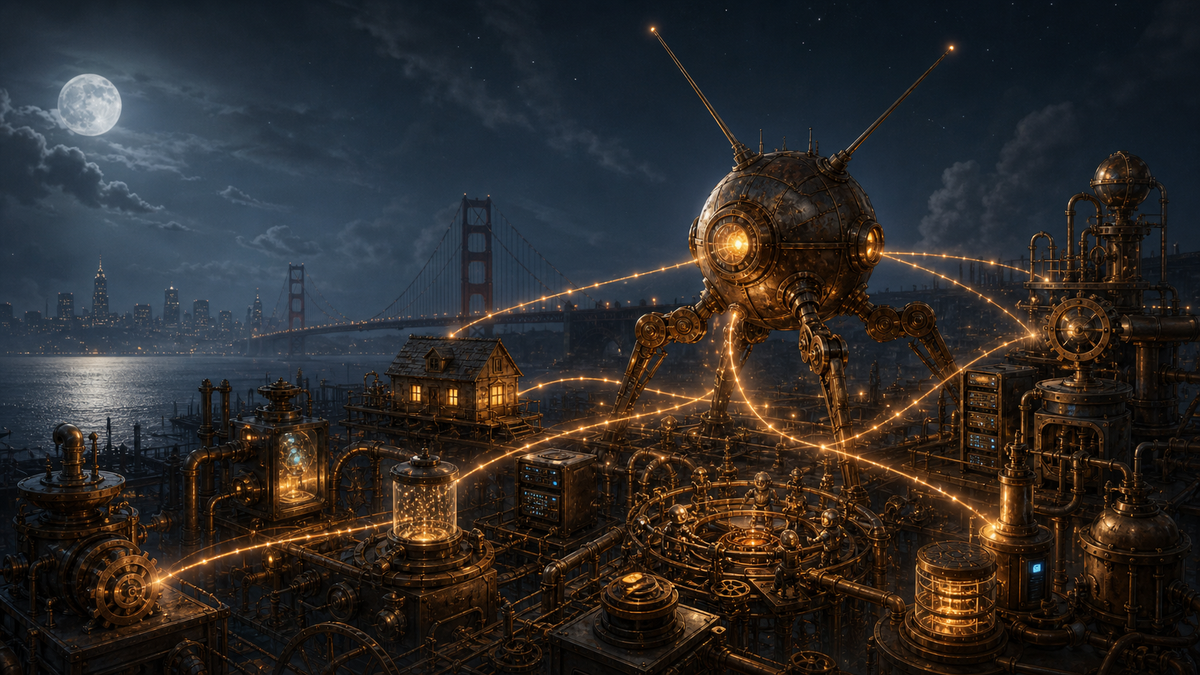
The shortest, deepest technical conference about Rust in AI: ten systems talks compressed into one three-and-a-half-hour San Francisco meetup.
Rust AI Begins was built as a technical sprint.
On July 27, 2026, builders gathered at AWS Builder Loft in San Francisco to show where Rust is already reshaping AI and data infrastructure. There were no forty-five-minute product keynotes and no day-long gap between the question and the implementation. Ten talks moved in quick succession through lakehouses, streaming, context engines, key-value systems, semantic layers, Delta Lake, agent connectivity, durable workflows, Postgres graph retrieval, and Python execution on Tokio.
Call it a meetup because that is how the community gathered. In technical density, it was a conference: perhaps the shortest, deepest technical conference yet devoted to Rust in AI.
Now the complete FunctionalTV release is live—one introduction, all ten technical sessions, and one speaker interview. Watch the whole collection, in reviewed event order, at devreal.ai/rust-ai-begins.
Built by practitioners
Alexy Khrabrov organized the evening with Scott Haines and Manvika Tuteja. The coorganizers are not event wranglers standing outside the subject: they are developers and speakers themselves.
Scott Haines is a Staff Developer Advocate and OSS Engineer at Databricks and a working open-source practitioner and conference speaker. He helped shape and host this inaugural program. He is not the Scott in the recorded delta-kernel-rs session—that speaker is Scott Sandre—but his technical point of view is part of why the evening moved at this pace.
Manvika Tuteja works in the AWS and Valkey communities, coorganized and hosted the event, and stepped directly into the program to deliver the Valkey GLIDE session included below.
Community events only look effortless after many people have made them possible. Video production for this release was supported by LakeSail. Databricks provided the food. AWS provided the drinks and welcomed the community into AWS Builder Loft. Thank you to all three for helping a very dense evening become an archive the wider Rust and AI community can now use.
What the program says about Rust and AI
The talks do not argue that every AI system should be rewritten in Rust. They show something more concrete: Rust is becoming the layer underneath the interfaces developers already use.
LakeSail keeps Spark compatibility while replacing the JVM runtime. LaserData builds real-time streaming around Apache Iggy. CocoIndex keeps AI context synchronized as source data changes. Valkey uses Rust to strengthen clients, modules, and data structures. QueryGraph connects lakehouse semantics to graph structure and type-level security. delta-kernel-rs centralizes Delta Lake protocol behavior for many engines. Columnar argues for Arrow-native ADBC as the connective tissue for agents. Temporal makes a Rust agent loop durable. pgGraph brings cache-conscious graph traversal into PostgreSQL. Daft runs Python coroutines through Tokio without turning every worker into a blocking bottleneck.
That is the significance of the gathering. Rust is not one product category inside AI. It is appearing across the whole substrate: execution, memory safety, interoperability, state, storage, retrieval, streaming, and governance.
Watch the complete program
1. Rust AI Begins: Introduction — Alexy Khrabrov
The community’s origins, the evening’s organizers, and a map of the projects about to take the stage. The introduction also makes the sponsor acknowledgements and explains why Rust has become so important to contemporary AI infrastructure.
2. Rebuilding the Spark Lakehouse Ecosystem in Rust — Shehab Amin, LakeSail
Shehab Amin presents Sail’s JVM-free, Spark-compatible architecture: planning, shuffle, Spark Connect, PySpark, Apache Arrow, Apache DataFusion, Delta Lake, and Iceberg integration. This is not a thin Rust wrapper around the old runtime; it is an attempt to preserve the developer interface while changing the execution foundation beneath it.
3. Building a Fast Streaming Service in Rust with Apache Iggy — Kranti Parisa, LaserData
Kranti Parisa explains how LaserData uses the Rust-native Apache Iggy engine for persistent, low-latency streaming. The talk gets into thread-per-core execution, io_uring, zero-copy serialization, and Kafka-compatible concepts rather than stopping at an architecture diagram.
4. CocoIndex: A Rust Context Engine for Production AI — Linghua Jin
AI context is not a one-time ingestion job. Linghua Jin shows how CocoIndex incrementally turns changing unstructured assets into extracted structures, search indices, knowledge graphs, and other continuously refreshed views for production AI.
5. Valkey GLIDE Overview — Manvika Tuteja
Coorganizer Manvika Tuteja surveys Valkey’s Rust ecosystem: the GLIDE client core, the Valkey Modules Rust SDK, and Valkey-Bloom. The session connects a familiar key-value foundation to the language and tooling being built around it now.
6. Lakehouse on Sail with Type-Level Semantics — Alexy Khrabrov, QueryGraph.ai
Alexy Khrabrov presents a lakehouse stack in which Sail meets an agentic semantic layer, LakeCat governance, Typesec and TypeDID security, and the Grust graph API. The question is not only how to run queries faster, but how agents can reason over data while policy remains part of the type-level structure.
7. delta-kernel-rs: A Shared Rust Kernel for the Delta Lake Protocol — Oussama Saoudi and Scott Sandre
Oussama Saoudi and Scott Sandre explain how delta-kernel-rs encapsulates Delta Lake metadata and protocol semantics behind an Engine Trait. DuckDB, Polars, DataFusion, and other engines can share the protocol logic instead of repeatedly implementing a subtle state machine on their own.
8. Universal Data Connectivity for Agentic Systems — Emil Sadek, Columnar
Agents need to cross systems quickly and predictably. Emil Sadek argues that ADBC’s vendor-neutral, Arrow-native interface is a better fit for that work than row-oriented APIs and a different SDK for every destination.
9. Rust Confessional: A Durable Agentic Loop on Temporal — Melanie Warrick and Melissa Herrera
Melanie Warrick and Melissa Herrera demonstrate a Rust agent that survives worker redeployment while keeping workflow state, retries, and human input. The session turns “agentic loop” from a demo pattern into an operational question about durability.
10. Extended Context for AI Agents with pgGraph and pgContext — Dalton Prescott Ng and Dale Everett Ng, Polygres
The Polygres founders show cache-conscious, multi-hop graph traversal inside PostgreSQL and explain how graph and vector retrieval can work together to give agents richer context without forcing every application into a separate graph stack.
11. Running Python Coroutines in Tokio for Daft — Everett Kleven and Srinivas Lade
Everett Kleven and Srinivas Lade describe how Daft bridges Python coroutines into a Rust Tokio runtime with PyO3. The result supports concurrent model, embedding, and external-service calls without blocking workers or pretending the Python GIL does not exist.
12. Shehab Amin on Sail and LakeSail — interview with Alexy Khrabrov
The bonus interview goes beyond the short session format. Shehab Amin and Alexy Khrabrov discuss the motivation for rebuilding a Spark-compatible lakehouse ecosystem with Rust, Arrow, DataFusion, Delta Lake, and Iceberg.
One event, now connected
The DevReal collection is more than a playlist. Each recording is connected to the event, its reviewed talk record, speakers, companies, projects, and the f.photo event gallery. That makes it possible to begin with one subject—streaming, lakehouses, graph retrieval, durable agents—and follow the people and systems around it.
If you spoke or helped build one of these projects, sign in to DevReal with LinkedIn, find your person node, and request ownership. Connect GitHub to add your verified handle and strengthen the evidence around your profile. Then help complete the relationships the archive cannot infer safely on its own.
Start with all 12 Rust AI Begins recordings. Browse the event photographs. If you are building where Rust, AI, and data meet, propose a future Rust AI talk.
Rust AI began as one very full evening. The archive is how the conversation continues.
published with omnighost · SHA-256 ba3534a3d5ed5ca32ab20f68c6c5fded4f530decb81f9d2f1ecc1f3ead41634a